
Students of class II b together with their teachers Barbara Sykulska and Elwira Madeiska prepared a historical-theatrical performance commemorating the Warsaw Uprising. The performance featured, among other things, poems by Krzysztof Kamil Baczyński and Tadeusz Gajcy, as well as excerpts from Miron Białoszewski’s “A Memoir of the Warsaw Uprising.”
“I’ve always wanted to stage a performance like this. It’s an important event; after all, it was an attempt by Poles to regain independence,” she says Barbara Sykulska, history teacher. And she announces: “Next year marks the 70th anniversary of the outbreak of the uprising. We will commemorate it on an even grander scale.”
Gallery (11)


Show remaining photos (8)


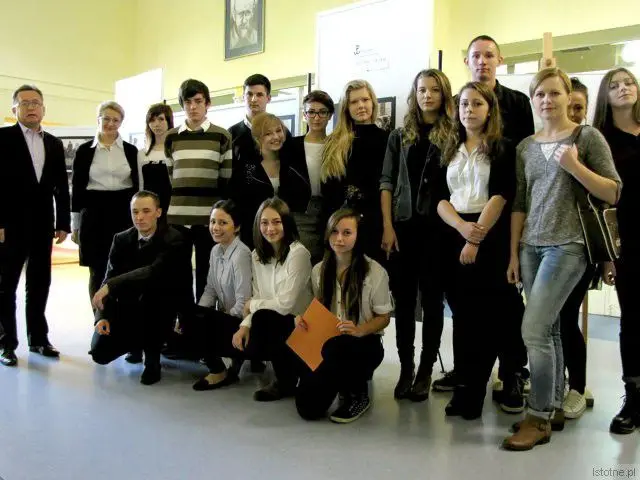
“We called this project ‘Memory Open Like a Landscape.’ We wanted to encourage reflection on remembering itself,” she notes Elwira Madeiska, Polish language teacher. – It turned out that young people are only seemingly absorbed by the present. In reality, they do not forget the past and have a great deal of idealism in them.
Both women emphasize that they work together very well. And they add that they are already working on another project, this time devoted to martial law.
“It was a fantastic performance; I am very moved,” he said after the show Mirosław Sakowski, director of II LO. – I am glad that the students of this school remember events so important to Poland.
Importantly, a group of students from the school (Paulina Bartków, Natalia Horodyska, Kacper Jędrzejewski, Magdalena Kowalczyk, Kamila Kozioł, Roksana Kuduk, Monika Mićić, Natalia Niczyporuk, Aneta Perońska, Katarzyna Puzio, Angelika Roztoczyńska, Aleksandra Siembida, Justyna Szafrańska, Anna Szweda, Karolina Tokarska, Agata Tur, Klaudia Wilk and Natalia Wolańska) took part in the project “Saving from Oblivion – Siberians,” which culminated in the publication “We did not have a childhood. Memories of Bolesławiec deportees to Siberia” edited by Anna Gorzkowicz and Ewa Ołenicz-Bernacka from Municipal Lower Secondary School No. 2 and Anny Puk from the Museum of Ceramics.
The book is the result of the work of 121 primary, lower-secondary and upper-secondary school students who, under the supervision of 18 teachers, collected and compiled biographical profiles of 63 Siberian deportees living in the city and county.
“We are proud to have been among the co-authors of this publication,” she states Barbara Sykulska. – I took part in this project because I wanted to learn more about my ancestors. It was truly an interesting adventure,” she says Paulina Bartków, who together with Roksana Kuduk prepared the biography Jadwiga Ross.
Biography Łucja Bajowska prepared Aleksandra Siembida and Natalia Horodyska. – Mrs Łucja was deeply moved by our visit – Aleksandra relates. – It was not easy for her to recall those events. She cried when she told us about her mother’s death. Her mother died of starvation because she gave her food to her children.

Kacper Jędrzejewski, who together with Magdalena Kowalczyk and Justyna Szafrańska prepared the biography Mieczysława Pettersa: – Mr Petters is a true hero to me. His story was worth preserving. I already know that this meeting will play a major role in my life. Thanks to Mr Petters, I look at older people differently. They are the ones who created history.
– I would like to thank this entire group – she adds Barbara Sykulska. – They are humanists in the truest sense. They are interested not only in textbook knowledge, but also in living history.
(information: GA)