
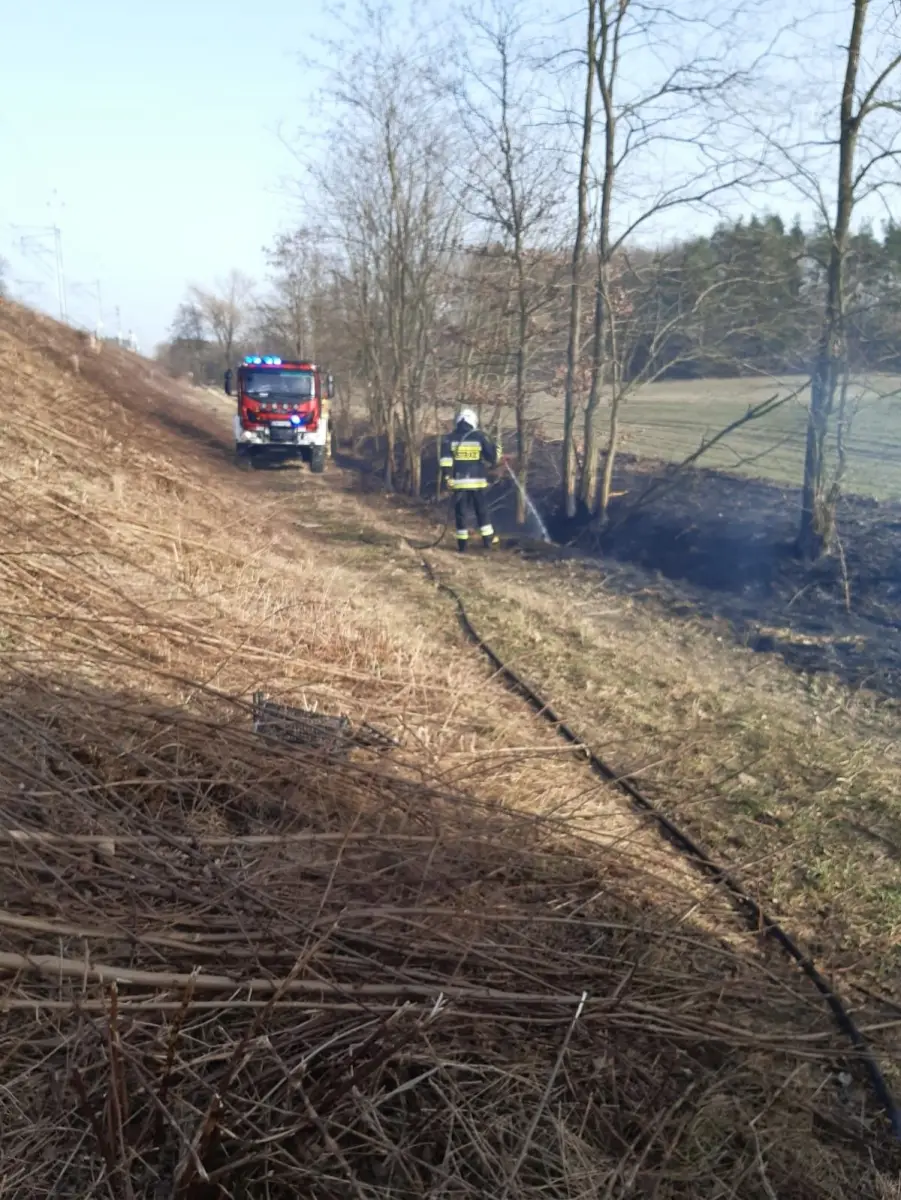
The incident occurred on February 25. Volunteer firefighters from Różyniec:
2:23 p.m. – dispatch to a grass fire on wasteland in the village of Kraśnik Górny.
Firefighters from Bolesławiec and Różyniec took part in the operation. Fortunately, no one was injured.
In Poland, 153,520 fires were recorded in 2019, including 55,912 grass fires on meadows and agricultural wasteland, accounting for approximately 36.4% of all fires in Poland. As reported by stoppozaromtraw.pl, the greatest number of grass fires was recorded in March and April—31,720 in total, accounting for 56.7% of all grass fires in 2019.
In 2019, there were 55,912 grass fires. More than 24,151 hectares of grassland burned.
Stoppozaromtraw.pl:
The transition from winter to spring is a period when the number of grass fires on meadows and agricultural wasteland rises significantly. This is caused by the burning of dry grass and plant residue. Areas of dried vegetation from the previous year are excellent fuel, and combined with human irresponsibility, this results in a sharp increase in fires. People are responsible for most grass fires. Unfortunately, many people believe that burning dry grass naturally fertilizes the soil, leading to faster and more abundant growth of young grass and thus bringing economic benefits.
How quickly does such a fire spread?
A fire can spread at more than 20 km/h (a fast run is nearly 19 km/h, while fast cycling is approximately 30 km/h). Wind also helps spread the flames. When the wind is strong and changes direction suddenly, fires very often get out of control and spread to nearby forests and buildings.
Importantly, during a forest fire, animals panic. Many lose their bearings and run straight into the flames!
Are people also among those affected?
National Headquarters of the State Fire Service:
People repeatedly lose everything they own in such fires. They also pose a direct threat to the health and lives of people and animals.
What are the economic consequences of grass fires?
Fires in meadows and forests cause enormous material losses. The accumulated wealth of many generations often goes up in smoke. Estimated losses resulting from grass fires in 2019 amounted to PLN 40,974,800. The average duration of grass-fire suppression operations is 54 minutes.
In 2018, firefighters were dispatched to grass and agricultural-wasteland fires every 9 minutes on average.
Is burning grass legal?
Firefighters:
The ban on burning grass is set out in the following legal acts:
- The Act of April 16, 2004 on Nature Conservation (Journal of Laws 2018, item 142):
- Article 131, point 12: “It is prohibited to burn meadows, pastures, wasteland, ditches, roadside strips, railway lines, reed beds and rushes.”
- Article 131: “Anyone who burns meadows, pastures, wasteland, ditches, roadside strips, railway lines, reed beds or rushes is subject to arrest or a fine.”
- The Act of September 28, 1991 on Forests (Journal of Laws 2017, item 788):
- Article 30, paragraph 3, point 3: “in forests and forested areas, as well as within 100 meters of the forest boundary, activities and actions that may create a hazard are prohibited, in particular: lighting fires outside places designated for this purpose by the forest owner or forest district manager, using an open flame, burning the topsoil and plant residue.”
What are the penalties for burning grass?
- Article 82 of the Act of May 20, 1971, Code of Petty Offenses (Journal of Laws 2018, item 618)—arrest, a reprimand or a fine which, pursuant to Article 24, paragraph 1, may range from PLN 20 to PLN 5,000.
- Article 163, paragraph 1 of the Act of June 6, 1997, Criminal Code (Journal of Laws 1997, No. 88, item 553, as amended): “Anyone who causes an incident that endangers the life or health of many people or property on a large scale, in the form of a fire, is subject to imprisonment from one to ten years.”
Losses Affect More Than Property
National Headquarters of the State Fire Service:
In 2019, during rescue operations related to extinguishing grass fires, 183,412,171 liters of water were used, equivalent to the capacity of 49 Olympic-size swimming pools. Grass fires on wasteland, due to their nature and usually large size, engage large numbers of firefighters and rescue resources. Every such intervention represents a serious financial expense.
Uniformed officers emphasize:
Firefighters involved in extinguishing grass fires on meadows and wasteland may at the same time be needed to save human life, health and property elsewhere. It may happen that, because of people's recklessness related to burning grass, they will not arrive in time where they are urgently needed.