
Jacek Pałkiewicz was introduced to the audience gathered at the “Format” gallery by his friend and journalist Krzysztof Petek. – People should have dreams, Petek said. – Some have only fantasies, but there are also those who make their dreams come true. Jacek Pałkiewicz is such a person.
Jacek Pałkiewicz’s source of dreams springs from one of Poland’s provincial towns. As a child, he read Fiedler’s books and, like all his peers, dreamed of traveling around the world and discovering the Amazon rainforest.
He first traveled along the routes of the heroes from adventure books in the 1970s. Flying over the Amazon, he gazed in fascination at a river so vast that, as he said, no human language has enough words to describe its size and beauty.
The Amazon pours almost 200,000 cubic meters of water into the Atlantic every second. Its mouth is 300 kilometers wide. Taking the length of its meanders into account, it is the world’s longest river, with the largest basin, measured in millions of square kilometers. The Amazon flows through a still-wild and dangerous green hell (inferno verde), full of unexplored Indigenous tribes, exotic animals, unsettling legends and fairy tales.

Despite the advanced science available to humanity at the end of the 20th century, no one knew where the Great River actually began.
“In the Encyclopaedia Britannica,” Pałkiewicz said at the meeting, “one of the most meticulous sources of knowledge, there was only the laconic information that the Amazon begins high in the Andes.”
Jacek Pałkiewicz did not merely ask where the Amazon’s source was. He found it during a scientific expedition organized in 1996.
The search for the source of the Amazon was also a fascinating journey through nature reserves, roads of death, lost cities, the jungle and legal coca plantations. Coca leaves mixed with lime, which helps release saliva, allow travelers to better withstand cold and high altitudes, stave off hunger, gain energy, improve performance and lift their spirits.
“At an altitude of 5,000 meters above sea level—and we studied the sources of the Amazon at such elevations,” Pałkiewicz recounted—“headaches and the sensation of heaviness in the head are extremely intense. It cannot be compared to anything except a hangover raised to the nth power. According to Indigenous beliefs, altitude sickness is a divine barrier for the bold who would like to climb peaks lying too close to the sky.”
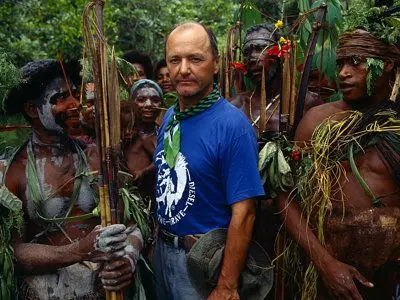
The traveler’s stories about Indigenous tribes whose lives are integrated with those of animals were equally fascinating. Monkeys are eaten there, but young ones are sometimes fed by human wet nurses when their animal mother dies. No less interesting was the story of a gold mine discovered at the beginning of the 21st century, where 50,000 gold prospectors fought for the smallest nugget under inhumane conditions, in an area the size of a football field.
The traveler also dispelled several common beliefs about the dangers of the Amazon.
“The tarantula, a spider people like to call a killer, has never killed anyone. And during thirty years of trips to South America, I have never met a witness who had seen a piranha attack a human. Although,” Pałkiewicz added, “there are tourist excursions to catch piranhas, which are fed bloody pieces of meat to the delight of tourists in order to perpetuate the legend of their bloodthirsty nature.”
The explorer also described his encounter with a puma.
“I came across it in the jungle; it was standing a few meters away from me. I knew I could not escape from such a fast and agile animal. But after a moment’s thought, I decided that there was plenty of food in its territory and that the predator must be well fed. When I began discreetly signaling to my photographer to ‘take down’ the puma, the animal calmly moved away without causing me the slightest harm.
Jacek Pałkiewicz spoke interestingly and with extraordinary passion about his travels, leaving a deep conviction that he is a man who does not merely dream. He makes his dreams come true. For, as he writes: “One must summon courage, draw out a strong conviction from within, show some determination and boldly take that first, effective step.” Pałkiewicz is not only the creator of a survival school for difficult conditions; he also teaches the survival skills of dreams.
About the expedition to the source of the Amazon
During the “Amazon Source’96” expedition organized by Jacek Pałkiewicz, systematic research was conducted for the first time using criteria consistent with modern scientific requirements. Two scientific disciplines were used in the research, among others: hydrology (a natural science concerned with the study of the closed cycle of water circulation in nature) and hydrography (the science concerned with measuring and describing bodies of water). Satellite photogrammetry was also used to determine the source of the Amazon (photogrammetry is a field of science and technology concerned with reconstructing the shapes, dimensions and relative positions of objects in the terrain—source: Wikipedia).
The “Amazon Source’ 96” team consisted of: Zaniel Novoa, an engineer; Admiral Guillermo Faura; glaciologist Dr. Siergiej Usznurcew; drainage engineer Rimma Chajrutdinowa; hydrologist Raul Rojas; explorer Renzo Grego; and mountaineer Juan Tord.
Jacek Pałkiewicz’s expedition report was recognized by the Governing Council of the Peruvian Geographical Society as the most important research on the source of the Amazon. The council pledged to promote this discovery.

The information used in this article comes from Jacek Pałkiewicz’s book “Amazon. The Riddle of the Source of the Queen of Rivers.”