
Non-Public Healthcare Facility PROVITA is organizing for the second time a scientific session, where the latest concepts concerning temporomandibular joint dysfunctions, methods of diagnosing these dysfunctions, as well as therapeutic and self-therapy techniques used in patients with this problem will be presented.
Date
- Friday, 20 April, a session open to everyone interested, admission free, starting at 2:00 p.m.
- Saturday, 21 April, a meeting for primary care physicians, dentists, otolaryngologists, ophthalmologists, speech therapists, physiotherapists and nurses, starting at 9:00 a.m.
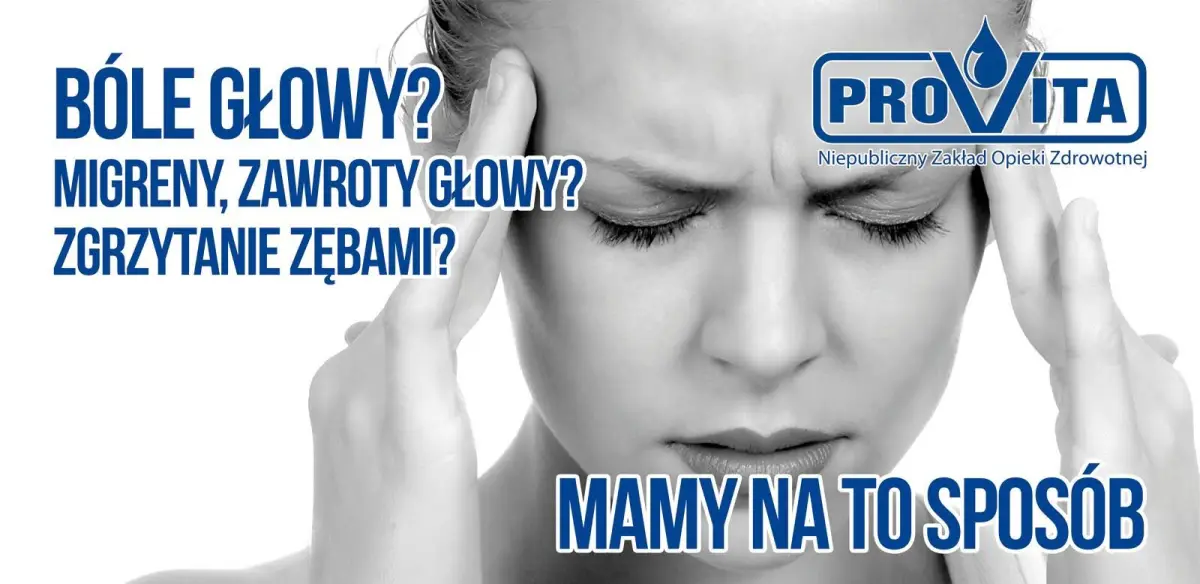
For years, NZOZ Provita has successfully provided therapy for people with complaints such as headaches, migraines, dizziness, and non-organic pain in the face, eyes, ears and teeth (no cause is found in examinations). Provita patients know that complaints of this type can be managed completely without medication. Such therapy is extremely effective.
The scientific session is being organized for the second consecutive year. It is a completely free scientific meeting for medical personnel from Bolesławiec and the surrounding area. The speakers are practitioners and specialists working at NZOZ Provita. Last year’s meeting, devoted to the pelvic floor, attracted very high attendance. One hundred people, including doctors, nurses and physiotherapists, attended the session.
The therapy conducted at NZOZ Provita is supervised academically by the well-known Bolesławiec doctor Janina Słobodzian-Rakowska, who has been a national authority in the field of manual therapy for years, a co-creator of Holistic Manual Therapy and one of only three teachers of this method in Poland.
The session is held under the patronage of the Mayor of Bolesławiec, Piotr Roman. The partner is Abena. The media patron is the portal istotne.pl.
Programme of the 2018 scientific session
Friday, 20 April
- 2:00–2:45 p.m. lecture by Dr Janina Słobodzian-Rakowska, MD, PhD Janina Słobodzian-Rakowska
What is the temporomandibular joint? Stress in the temporomandibular joint.
Where can headaches and dizziness, and pain in the face, eyes, ears and throat come from if examinations show no cause for these complaints? Questions and answers – 5 min. - 2:45–3:15 p.m. lecture by dentist Małgorzata Mincel-Jancelewicz
Symptoms of temporomandibular joint dysfunction from a dentist’s perspective. Cooperation between a dentist and a physiotherapist. - 3:15–4:00 p.m. MSc Anna Garwolińska
Self-therapy – practical ways of managing temporomandibular joint dysfunction independently. Questions and answers. - 4:00–4:15 p.m. Aleksandra Semenowicz
Better hearing means a better life.
Saturday, 21 April
- 9:00–9:45 a.m. Dr Janina Słobodzian-Rakowska, MD, PhD Janina Słobodzian-Rakowska
Causes, symptoms and ways of managing patients suffering from dysfunction of the mandibular–hyoid–cranial system. Questions and answers – 5 min. - 9:50–10:30 a.m. dentist Małgorzata Mincel-Jancelewicz
The Cadiax electronic system as an effective tool in the interdisciplinary diagnosis and therapy of temporomandibular joints – personal experience and a practical presentation of the method. Questions and answers – 5 min. - 10:35–11:15 a.m. MSc Anna Garwolińska
Self-therapy – practical ways of managing temporomandibular joint dysfunction independently. Questions and answers – 5 min. - 11:25–11:50 a.m. coffee break
- 11:50 a.m.–12:10 p.m. MSc Konrad Słobodzian
Interactions – reflex connections between the mandibular–hyoid–cranial system and other parts of the musculoskeletal system. Questions and answers – 5 min. - 12:15–12:40 p.m. MSc Olga Szulik, MSc Joanna Janeczko, MSc Remigiusz Dereszyński
Case study – presentation of the examination, therapy and self-therapy methods for a patient
with dysfunction of the mandibular–hyoid–cranial system. Questions and answers – 5 min. - 12:45–1:10 p.m. MSc Agnieszka Górna, MSc Anna Rękoś, Małgorzata Jurasik
Physiotherapy used in temporomandibular joint disorders.
Questions and answers – 5 min. - 1:15–1:40 p.m. BSc Alina Stempak. What determines healthy sleep? Questions and answers – 5 min.
About the mandibular–hyoid–cranial system
Based on anatomical and physiological knowledge, we can attribute very specific functions to the mandibular–hyoid–cranial system: biting, chewing, swallowing, speech, singing and conveying information about experienced emotions. However, this system, of which the temporomandibular joints are an integral part, is much more significant because it determines many functions throughout the human body.
This is due, among other things, to the fact that the cranio-cervical junction is closely connected with the cranial nerves, on which the function of many internal organs depends, including the heart, lungs, organs of the digestive tract and the lesser pelvis. Through appropriate neural pathways, pathological information from the areas and organs mentioned can also disrupt the functions of the structures of the mandibular–hyoid–cranial system.
These interactions between the craniofacial area and the entire musculoskeletal system, and through it also the internal organs, are overlooked by many specialists when working with patients suffering from temporomandibular joint complaints. An additional factor complicating the diagnosis and subsequent therapy of these patients is the fact that the mandibular–hyoid–cranial system is an extremely sensitive receiver of stress. It is in the tissues of this system that a person’s reactions connected with parental patterns and experiencing primary emotions, such as anger, rage and disagreement with the existing situation, are recorded.
Experiencing violence or a parent’s alcoholism is always “recorded” in tissue memory, mainly within the craniofacial structures. Dysfunction of the mandibular–hyoid–cranial system can provoke a range of unpleasant symptoms: pain in healthy teeth, headaches, and eye and ear pain without pathological causes, dizziness, difficulties with voice production and many others. Therefore, specialists from various fields should cooperate when working with a patient experiencing complaints in this area, including a dentist, orthodontist, otolaryngologist, phoniatrist, ophthalmologist, psychologist, physiotherapist and others, depending on the needs.
Dr Janina Słobodzian-Rakowska, MD, PhD

