
Mining is associated primarily with the Upper Silesia region. In Lower Silesia, copper extraction is the dominant industry. Very rich deposits of this raw material, discovered in the late 1950s, led to the creation and development of the copper basin around Lubin and Polkowice. For a long time, however, our region was also known for hard-coal mining. Lower Silesia still abounds in rich deposits of “black gold.” Before World War II, the so-called Lower Silesian Coal Basin comprised numerous mining facilities that drove the German economy.
Unfortunately, a miner’s work carries considerable risk. Recent tragic events in Polkowice and the widely reported disaster at the Halemba mine in 2006 claimed many lives. Pre-war Lower Silesia also experienced such tragedies. In the summer of 1930, as many as 151 people died in one of Lower Silesia’s mines. It was the most tragic mining accident in the modern history of mining in Lower Silesia.
The entire story unfolded at the Wenceslaus (Wacław) Mine in Ludwikowice Kłodzkie. Let us begin at the beginning.
The first references to coal extraction in the area around Nowa Ruda date back to the 15th century. The modern era of mining in this area began in 1771, when Baron von Haugwitz, the owner of the upper part of the village of Jugów, opened a mine. The facility was subsequently acquired by Friedrich August von Stillfried. In 1810, the aristocrat sold the mine to Count Magnis. Two years later, it became the property of Lieutenant von Bonge. His family managed the mine until 1855. Between 1884 and 1887, it became the property of a French investment group. In 1897, lawyer Dr. Gustaw Linnartz bought all the shares.
At the turn of the 19th and 20th centuries, an 18 MW power plant was built. It was powered by sludge from a nearby mine. The power plant operated until 1964.
The mine’s location requires some clarification. It was situated in the settlement of Miłków, located in the Central Sudetes, near the Wyrębińskie Hills. Miłków is specifically a settlement belonging to the village of Ludwikowice Kłodzkie. Its German name, which can be found on German postcards, was Mölke.
The Wenceslaus Mine (pronounced: venkslaus) was the most modern mine in the Lower Silesian Coal Basin. Fully electrified, it had a conveyor belt for transporting extracted material and its own narrow-gauge railway.
In 1897, the Walter shaft was deepened, and just three years later annual coal production reached 185,721 tons [R. Borzęcki, M. Bodlak, Historia eksploatacji węgla kamiennego w rejonie dawnej kopalni Wacław w Ludwikowicach Kłodzkich na Dolnym Śląsku, s. 157–161].
The following shafts existed at Wenceslaus:
- Kunegunda (Wacław after 1945) – 417 m deep
- Walter (Wanda) – 610 m deep
- Kurt (Ludmiła) – 310 m deep
- Baltazar (ventilation shaft) – 350 m deep.
The interwar years were a turning point for the mine. Germany had lost most of Upper Silesia, and hard coal was then the main fuel for industry. In 1921, the Wencesclaus company was established, headquartered in Ludwikowice Kłodzkie (German: Ludwigsdorf). It could be said that the facility’s development also became its downfall. In 1924, production had already reached more than 629,927 tons. The previous year, the mine had recorded the highest employment in its history – nearly 4,600 miners and 250 administrative employees. In 1929, record production of 900,000 tons was achieved.
The accident that occurred on July 9, 1930, was a disaster both for the facility and for the entire surrounding area. At around 4:00 p.m., a carbon-dioxide outburst occurred on the third level of the Kurt shaft in Jugów. This in turn caused a 35-meter-long block of rock to collapse. The entire wall of the excavation began to cave in. In total, 3,354 tons of rock collapsed. As a result of this tragic event, as many as 151 miners died underground.
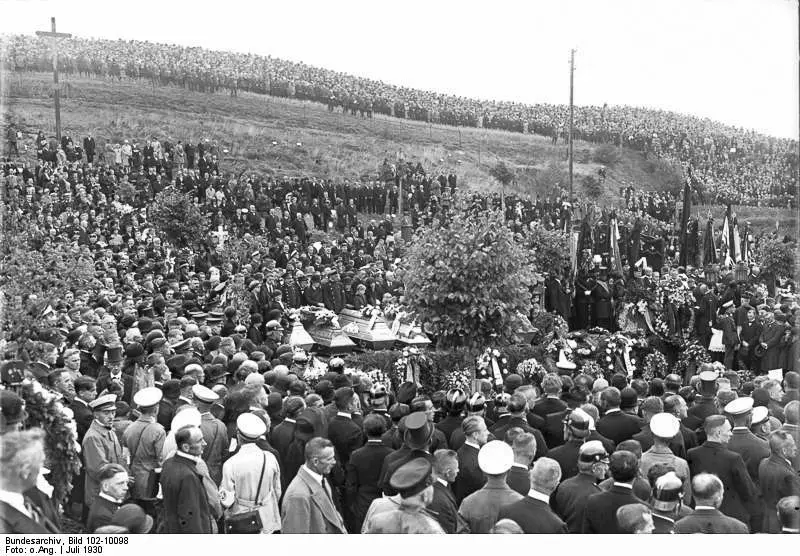
All the victims of the disaster were buried in a separate section of the cemetery in Jugów. Approximately 20,000 people, including representatives of the German authorities, attended the funeral ceremonies. A small chapel was also erected in memory of the victims. The miners’ graves survived the turmoil of war, but unfortunately were removed in the 1990s, which I personally consider a very inappropriate action on the part of the cemetery administrator.
A year after these tragic events, the mine was closed. It was reopened between 1933 and 1939. During the final period of its operation, the facility fell into debt. Production was reduced by 70%, and the economic crisis contributed to a decline in the price of coal. In the 1940s, Dynamit Nobel A.G. produced ammunition on the mine’s premises. After World War II, coal extraction was never resumed.
At the time, the Wenceslaus Mine was the most modern and most productive hard-coal mine in Lower Silesia. The coal extracted there was so-called anthracite – a type of coal with the highest content of this element. This kind of coal is ideal for producing coke and is used in metallurgy and electrode manufacturing. Unfortunately, the mining fields beneath Ludwikowice Kłodzkie, Miłków, and Jugów are among the most gas-laden in Europe. In 2004, a Scottish company showed interest in the mine. In 2013, Australians conducted exploratory drilling. The size of the deposit in Ludwikowice is estimated at approximately 180 million tons.
Paweł Skiersinis

The author is a blogger and history enthusiast, particularly interested in the history of Lower Silesia and Poland. Why Lower Silesia? As he says: “Why not? The most fascinating history is the history around us, concerning us and our ancestors.”
He adds: “I try to present history from a different perspective, in an interesting way, not in the typical textbook style, full of dry dates and facts. My articles concern facts that cannot be found in textbooks and well-known publications. The history of Lower Silesia is undoubtedly interesting and fascinating, so it is worth devoting at least a brief moment to it from time to time.”