
On Tuesday, we reported that further human remains had been exhumed near Młodzieżowy Dom Kultury—in a building that housed a Gestapo headquarters during the Second World War and, immediately after the war, the headquarters of the Security Office. The case has sparked controversy, discussion and debate. Its significance may be demonstrated by the fact that it has attracted interest not only from local and regional media, but also from nationwide outlets.
In Tuesday’s article, we also wrote that, thanks to the media attention surrounding the grim mystery of the underground rooms beneath Bolesławiec’s cultural centre, a letter from a German woman who had been imprisoned for a year at the headquarters of the Bolesławiec Security Office reached researchers at the Institute of National Remembrance and Zdzisław Abramowicz. Today—as the first outlet—we present a translation of this letter, prepared by Alicja Rykowska.
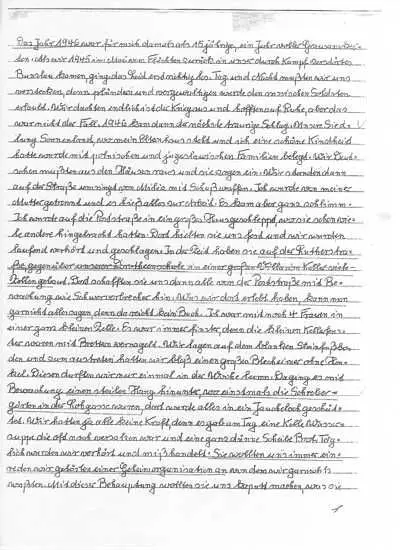


Translation
The year 1946 was a year filled with horror for me, then a 15-year-old. When we returned from fleeing to our Bolesławiec, devastated by the war, in May 1945, our suffering truly began. Day and night, we had to hide because rape and robbery were permitted for Russian soldiers. We thought the war had finally ended and hoped for peace, but that was not the case.
In 1946, another sad event occurred. Our “Sonnenland” neighbourhood, where my parents’ home stood and where I had spent a beautiful childhood, was occupied by Polish and Yugoslav families. We Germans had to leave the house, and they moved in. We stood in the street, surrounded by armed militia. I was separated from my mother. Things were bad. I was taken to “Poststrasse” (today A. Mickiewicza Street—editor’s note), to a large house. Other people were already there. We were interrogated and beaten constantly. At that time, many small rooms were being built in the basement of a large villa on “Lutherstrasse” (today Grunwaldzka Street), opposite our “Dorothenschule” school. Later, we were taken there from “Poststrasse” under special guard—as if we were criminals. What we experienced there cannot be described. A book would not be enough.
I was in a very small cell with four other women. It was always dark because the windows had been boarded up. We lay on a stone floor, and our only toilet was a tin bucket without a lid. We could empty it only once a week. There was a large hole in the allotment garden, and everything was buried there. We had no strength because each day we received only a ladleful of watery soup, often oversalted, and a thin slice of bread. We were interrogated and humiliated every day. They wanted to convince us that we belonged to a secret organisation we knew nothing about. They simply wanted to kill us—that was their intention. We could wash our hands and faces once a week, with cold water.
Once, I do not know what day it was, a guard took me from the cell, and I began trembling with fear. Suddenly, he opened the door of another cell, and a priest was lying on a bunk inside. I thought he was dead because he did not move. Candles were burning on his right and left, and his hands were folded. I had to take the bucket from the cell with me. I do not know what they did with the priest afterwards. Many people died in that basement and were then thrown into a hole that was later filled in. Some were taken out of their cells and never returned, and we did not know what had happened to them. After a year, I became very ill; I had typhus—there was no help.
Fortunately, I found my mother. She had been transported to “Antonienhof” to work. There was a very good Polish inspector there who had lived in Austria for a long time and was named Silvester Lipski. He was surprised when he saw me. That was when I learned that they had transported many people to forced labour, while others simply had to die.
After all that suffering, I was fortunate to leave the place after a year. At the same time, I was told that if I said even one word publicly about that basement, I would end up there again.
I always say that it is hard to believe what I went through. I am now 75, and we are the last generation that knows anything about it.
Despite everything, our beautiful Bolesławiec will always remain my homeland. Every year, I go to Bolesławiec with my children for a few days because we still have German-born acquaintances there. I stand in front of that villa for a few minutes, and everything comes back to me. Much has changed in Bolesławiec in recent years. A second generation of Poles has already grown up. That, in brief, is everything.
Hildegard Moebius (Möbius)
(translation by Alicja Rykowska, information GA/ KG)