
The opening of the “Imago mundi” exhibition took place on 18 August in the Ceramics Museum building on Mickiewicza Street. The exhibition presents ceramic-sculptural works by Janina Karczewska-Konieczna and her husband Stanisław Konieczny, artists from Gdańsk. Almost all the works were made of ceramics. The only exception, the most monumental piece—“The Tree of Jesse” by Janina Karczewska-Konieczna—is made of plaster.

Many of the works gathered at the exhibition refer to religious motifs, including the “Angels” series and the aforementioned “The Tree of Jesse.” As Tadeusz Orawiec, the exhibition curator, emphasised, “Religion is absolute.” The same applies to art. “The meaning of art is the search for the absolute,” the curator added.


Janina Karczewska-Konieczna, who attended the opening, said that Bolesławiec is a beautiful city and that she “will keep inviting herself here,” because this is where art is born. After the opening, a multimedia presentation showing the achievements of the artists participating in this year’s edition of the International Ceramic and Sculptural Symposium was presented in the museum garden. The “Imago mundi” exhibition can be visited until the end of September.

Janina Karczewska-Konieczna is a graduate of the Faculty of Painting at PWSSP in Gdańsk. She also studied ceramics and graphic art. It was in the field of ceramic sculpture that she achieved her greatest successes. Her works are held in museum collections in Poland and abroad, including in Italy, France, Sweden and the Czech Republic.
Treasures of the Bolesławiec Land
The opening of the next exhibition took place on Sunday, 19 August, in the Ceramics Museum building on Kutuzowa Street. The exhibition “Treasures of the Bolesławiec Land—archaeology of the Bolesławiec region yesterday and today” presents the results of archaeological discoveries and research in our region, both pre-war and contemporary research (from 2005). Some of the exhibits come from the museum’s own collection, while others were loaned by the Archaeological Museum in Wrocław.
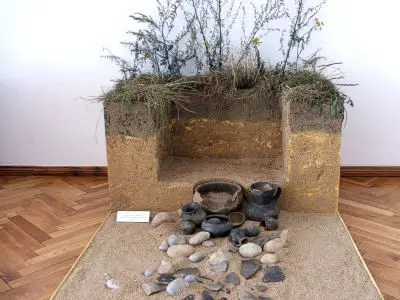

The exhibits are divided according to historical periods, from the Stone Age to the Middle Ages. Visitors can see, among other things, a reconstruction of a cremation grave and a funeral pyre from the Bronze Age, a spearhead from the period of Roman influence, ceramics and other objects. Eighty per cent of the finds are vessels, once again showing the important role that ceramics played in Bolesławiec County—as early as the Middle Ages!
The exhibition is one element of a project involving, alongside the Ceramics Museum and the Wrocław City Museum, the Bundesheimatgruppe Bunzlau in Siegburg. The project was co-financed by the Foundation for Polish-German Cooperation. The exhibition can be visited until mid-October.
(GA report)