
The Luger pistol was handed over to director Anna Bober-Tubaj by Colonel Paweł Świtalski, commander of the 23rd Silesian Artillery Regiment, during Bolesławiec’s celebrations of Rocket Forces and Artillery Day.
The pistol was found in July by Michał Rabuliński, an employee of “KAS-BUD”, during renovation work on the attic of one of the buildings belonging to the Bolesławiec barracks complex. The Luger was secured by Explosive Ordnance Disposal Patrol No. 23, commanded by Senior Warrant Officer Radosław Mazur.
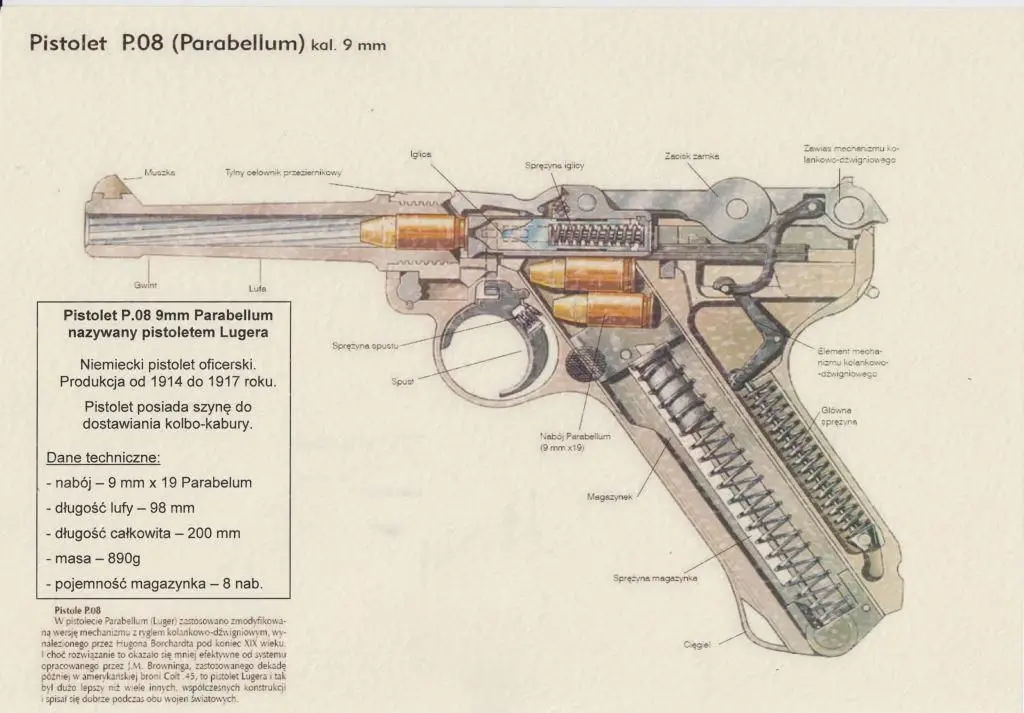
The history of the 9×19 mm P.08 Parabellum pistol, commonly called the “Luger” after its inventor, Georg Luger, dates back to the late 19th century. In this model, its creator used some of the solutions applied in the design of the Burchardt pistol, reducing the weapon’s weight and size. He also introduced numerous improvements concerning the pistol’s operation.

The weapon was produced in three versions differing in calibre and barrel length. Initially, as a 7.65×21 mm pistol, it was used by the Swiss Army. In 1906, a version adapted for the 9×19 mm cartridge was developed; in 1908, it entered service with soldiers of the German Empire under the official name Pistole 08.
The Luger replaced the older-design Reichsrevolver M/83. It was used in the German Army until 1945. It also served as standard equipment in the Swiss, Dutch, Greek, Bulgarian, Portuguese and other armies. The P08 pistol is characterised by its original design, smooth automatic operation, ergonomic shape and good balance. Many military experts considered the Luger the handiest and most precise military pistol in the world.
Despite its many advantages, the Luger had certain design shortcomings. It was susceptible to dirt, which made it unreliable in field conditions. In addition, its design was very complex, significantly increasing production costs. According to users of this type of weapon, one of its faults was also that it directed spent casings towards the shooter’s face. Ultimately, the Luger was replaced by the more efficient and easier-to-use Walther P-38.
The pistol transferred to the Museum of Ceramics was probably manufactured between 1914 and 1917. It has survived complete and in good technical condition, together with its original magazine. It displays individual features indicating an attempt to modify or improve its design.
In addition to the pistol, the Bolesławiec Museum also received an ammunition crate for a Soviet 45 mm cannon, bodies of German 75 mm and 88 mm anti-tank artillery shells, and the body of a Soviet 122 mm artillery shell, all found in the vicinity of Bolesławiec during the operations of Explosive Ordnance Disposal Patrol No. 23.
After all procedures have been completed and conservation work carried out, the pistol and shell bodies will be displayed in the permanent exhibition of the City History Department of the Museum of Ceramics in Bolesławiec. We sincerely thank you for the donated exhibits.

Information from the Museum of Ceramics/ii