
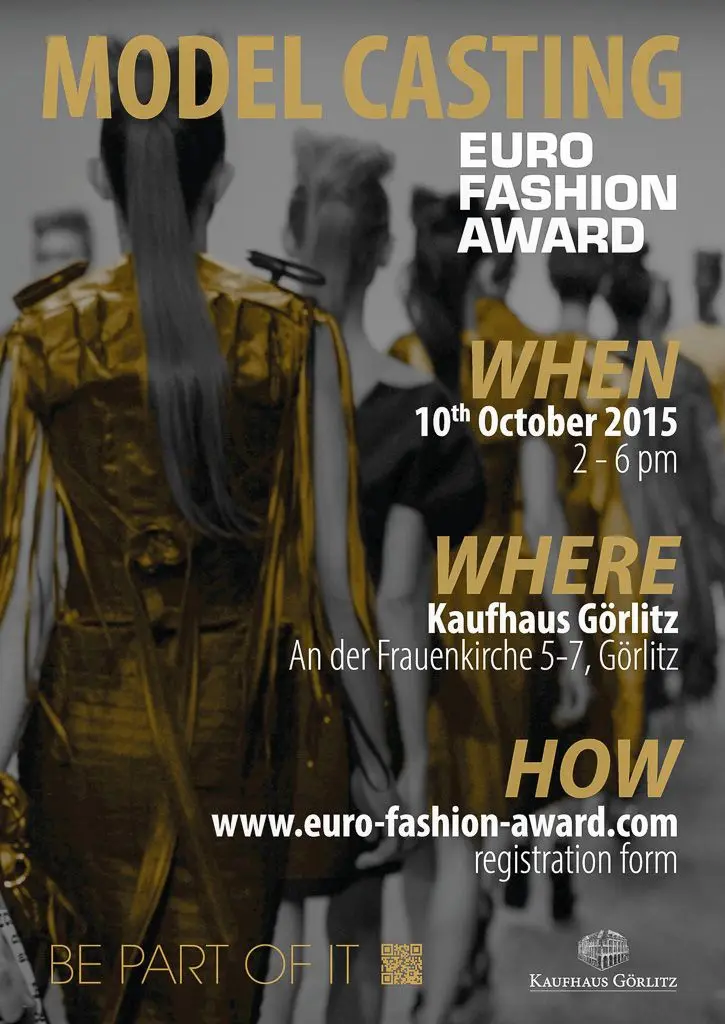
The competition itself will take place in April, but its accompanying events are already being held this autumn. In September, a “Lost Places” photography workshop was held in Görlitz, and soon, on 10 October, there will be a casting for those who would like to try their hand at modelling. Information about the requirements candidates should meet and the application form can be found at: https://www.euro-fashion-award.com/en/model-casting/.
Euro Fashion Award
The first edition of the competition for European fashion designers will take place on 23 April 2016. The event will be held regularly, so the world of fashion will visit the Neisse every spring. Young European fashion creators will be assessed by an international jury, which will include:
- Margareta van den Bosch, creative adviser and longtime head designer at H&M (Stockholm)
- Gudrun Allstädt, head of the women’s clothing section at a trade magazine for the textile industry (Frankfurt/M)
- Ann‐Merete Ohrt, professor at the Royal Danish Academy of Fine Arts (Copenhagen)
- Alexander Krenn, chief designer at the Vivienne Westwood fashion house (London)
- Elena Strahova, president of the Baltic Fashion Federation (Riga)
- Martina Glomb, professor at the fashion design department of the University of Hannover
- Steen Halbro, professor at the textile design department of the École Nationale Supérieure des Arts Décoratifs (ENSAD) in Paris
- Irina Sowitzki, fashion designer and associate of Kunsthochschule Berlin Weißensee
- Andrej Subarew, fashion designer and artistic director of the Euro Fashion Award.
Ten of the best creators will be invited to the competition final, where they will compete for three main prizes and the audience award, all funded by Kaufhaus Görlitz.
The idea of organising the EFA competition is, on the one hand, a reference to Görlitz’s weaving, cloth-making and trading traditions and, on the other, a natural consequence of the success of “filmic Görlitz”. Its “face”, or distinctive hallmark, became Wes Anerson’s film “The Grand Budapest Hotel”, which won four Oscars and is set mainly in the historic interiors of the Kaufhaus and Stadthalle, suitably arranged for the production.
Following the film’s success, the city, which had already been promoting itself as Görliwood for some time, decided to attract the attention of the fashion world as well. For the first time, it presented itself during Berlin Fashion Week as a “Location for the film and fashion industries”, where photographers and filmmakers alike can find many unique, inspiring places. No less important to the idea of organising a fashion competition in Görlitz—more precisely, in the historic interiors of the Art Nouveau Kaufhaus—is the European character of this binational city situated at the meeting point of three borders.
UM Zgorzelec/ii