
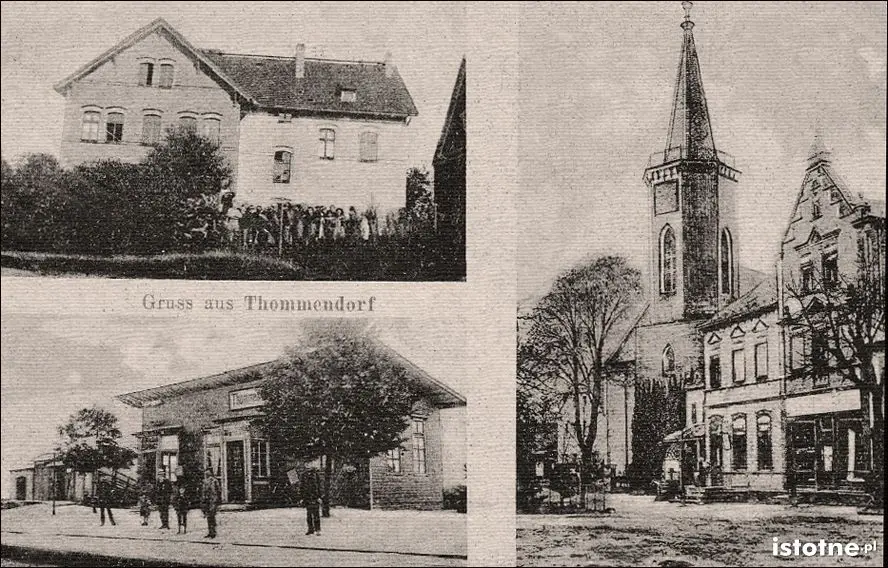
Until 1945, Tomisław was known by the German name Thommendorf. It is a settlement located on the left bank of the Kwisa River, probably established in the 13th century, with the beginnings of settlement dating back to the 4th century. The parish church was built in the 14th century and rebuilt in 1836–1837.
During the Reformation, the local population abandoned Catholicism, and the church building served followers of Martin Luther. Until the end of World War II, the settlement was self-sufficient, with shops, a school, a post office, a railway station and skilled specialists, such as a barber, tailor, wheelwright, butcher and midwife.
The history of the settlement is linked to the pastor and renowned poet Jan Rothe, who ministered there in the first half of the 18th century. Meanwhile, on February 1, 1934, Marja Młynkowa was born in the settlement. She was an outstanding Sorbian writer, literary critic and literary historian. She explored the difficult subject of the fate of Sorbian families during the Nazi period.
On February 13, 1945, Tomisław was occupied by Soviet troops, and in the summer it was transferred to the Polish administration. Settlement by Polish people, most of whom had arrived from Bosnia, then began. Today, the beauty of former Tomisław can be admired on old postcards.


Sebastian Zielonka – historian and graduate of the University of Wrocław. Specialization: archival studies and conservation documentation. He is interested in the history of the region and the social life of Europeans in the 20th century. In his free time, he travels.
Sources: W. Bena, A. Paczos, “Along the Kwisa”.