
Thanks to the monitoring system, PWiK has managed to reduce water losses by 40%. There are many causes of failures in the water supply network; what matters is stopping leaks quickly and preventing the loss of treated water. Reducing the time needed to repair a failure, and consequently the costs, has a significant impact on stabilizing water and sewerage bills.
– This is what the modern water supply network monitoring system, with its headquarters at the Modłowa Water Treatment Plant, and Intelligent Pressure Management are for – says technical director Grzegorz Kozłowski. – Bolesławiec is built mainly on sand, and many persistent water leaks would be impossible to detect without our system. In 2011, the company invested in a modern water supply network monitoring system. Thanks to it, we significantly reduced water losses caused by leaks. One of the major successes was the rapid repair of a failure on Bobrowa Street, which is located in such sandy terrain. The monitoring system alerted us that water consumption was alarmingly high. At night, the system recorded a loss of 7 cubic meters per hour. We immediately sent a team there. Before monitoring was introduced, failures could be detected only when water from the pipes appeared on the surface. During an inspection, such a leak could be noticed by employees or residents, who would then report the failure themselves. But in sandy terrain such as that on Bobrowa Street, the water seeped into the sand, and without our system such a failure would have been practically impossible to detect – the director explains.
Our new Modłowa – the control center
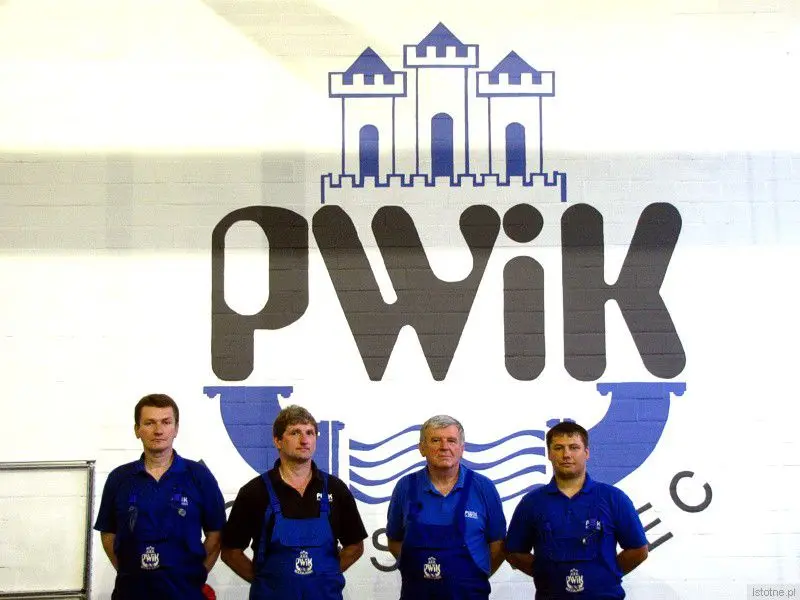
The modern control center is located at the Modłowa water treatment plant. The plant was modernized gradually. In the room where the pumps operate, the installations and flooring were replaced, and a new stainless-steel railing was installed. Once the walls had been painted, the employees decided that one of them should be specially decorated.
– The wall was empty, and someone suggested painting the PWiK logo on it – says the head of the water supply department Mieczysław Ryż. – We had had this idea for two years. First, there was a new floor, and the unpainted walls looked out of place, so we renovated the walls. Once the walls and floor looked nice, the old railing began to bother us, so we replaced that too. Then it was time for decorations. There was even a more artistic concept, but in the end five employees created the symbol of our company, choosing the right colors and carefully reproducing its exact shape.
The logo was painted by: Andrzej Mielnik, Władysław Popek, Kazimierz Zimirski, Stanisław Pokładek and Marian Kuśmierz.
Gallery (10)


Show remaining photos (7)


The dispatcher’s office was also renovated. This is the company’s electronic brain—the place where failures are detected and where a crisis team can also work efficiently. For this purpose, a large screen was installed on one of the walls. – Thanks to the screen, several people gathered there can conveniently view the situation – the department head explains.
Now the biggest task will have to be carried out in Lwówek, which became a partner in PWiK in Bolesławiec in March 2014. – In Lwówek, the most important thing is to ensure the security of water supplies – says Mieczysław Ryż. – Once we complete the necessary work and create a digital map there, we will connect Lwówek to our network and monitor that water intake from our center as well.
How was the monitoring system implemented in Bolesławiec?
To implement the monitoring system, Bolesławiec was divided into four zones defined by natural boundaries—rivers, railway tracks, or Karola Miarki Street. Measuring devices for water flow and pressure were installed at the boundaries, transmitting data via GPRS (a method of transmitting data over a GSM network) to the central monitoring system on Modłowa Street. The system is operated by an on-duty dispatcher 24 hours a day.
In addition to the monitoring system, PWiK in Bolesławiec also implemented an Intelligent Pressure Management system. – Pipes are most susceptible to leaks at night, when water consumption is lowest and pressure in the pipes is highest – explains Grzegorz Kozłowski. – Remotely controlled pressure-reduction units installed at the network’s main junctions temporarily reduce pressure at night, when the city’s water consumption is lowest. Uniform pressure in the pipes reduces cracking and their susceptibility to failures, while lower pressure also means smaller leaks when a failure occurs. We also ensure that residents receive reliable information about failures. Anyone who has subscribed to an e-invoice receives an SMS notification from us, and the location and type of the current failure can be found on our website under the failures and repairs section – the director adds.
Time to monitor the network in Lwówek Śląski
At the end of February 2014, Józef Król, president of the Water Supply and Sewerage Company in Bolesławiec, and Ludwik Kaziów, mayor of the Town and Municipality of Lwówek Śląski, signed a notarial deed under which Lwówek Śląski became a partner in PWiK in Bolesławiec.
– In the event of a failure, the entire town of Lwówek is currently left without water. In Bolesławiec, we now cut off only one street – says president Józef Król. – That is why we will introduce this modern failure-detection system in Lwówek in the near future. It will help minimize water losses, which will affect water bills. There are significant cost reserves in Lwówek. In Bolesławiec, over two years we reduced costs by PLN 800,000. This has a significant effect on the tariff. It is a success to maintain similar prices despite inflation. Let me remind you that we pay the same for wastewater as last year—PLN 6.46. For water, PLN 3.47. The increase is 2.9%. The average tariffs in Lower Silesia are PLN 7.06 for wastewater collection and PLN 4.50 for water supply. This is our goal: to keep prices unchanged or, if we must, raise them only minimally – adds the PWiK president.
(information: PWiK/ii)