
Two skeletons were found in the ground near the Youth Cultural Centre. They were approximately 3 metres apart. They had been buried fairly shallowly. It is believed that they are the remains of a woman and a man. A metal bra clasp was found next to one of the bodies. The remains had probably lain in the ground for more than half a century. What is more, it turns out that this was not the first discovery of this kind in Bolesławiec.
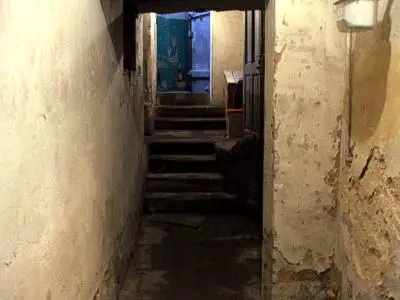
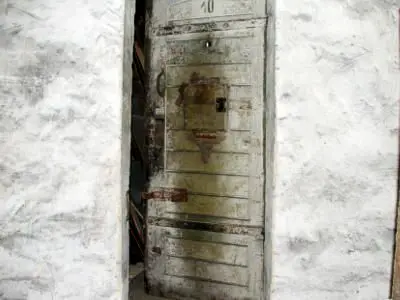
It is no coincidence that the macabre discovery was made near Bolesławiec’s cultural centre. During the Second World War, the building that now houses the Youth Cultural Centre was home to a Gestapo headquarters, and immediately after the war it was taken over by the security service. In its cells, under inhuman conditions, the Security Office detained and brutally interrogated people. “They used what the Germans had already prepared: cells and an area surrounded by barbed wire,” says Zdzisław Abramowicz, an expert on the history of Bolesławiec. The couple found there were probably victims either of the Nazis or of the communists.
A grim mystery
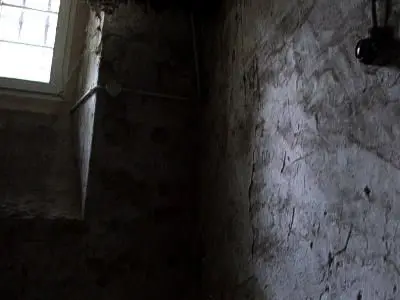
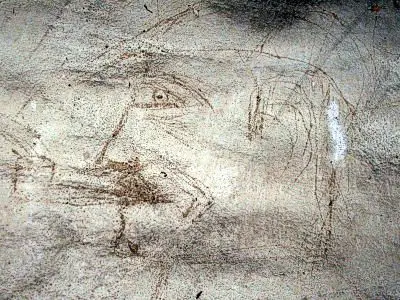
The security service probably held enemies of the system there until the end of the 1940s. “People were certainly still imprisoned there in 1949, because dates have been scratched into the basement,” Abramowicz explains. There is no doubt that Poles were held there. The cells contained only inscriptions in Polish, and one of the prisoners carved an eagle wearing a crown into the wall, barely visible today.
The assumptions of the history enthusiast from our region were also confirmed by a woman from Nowogrodziec, now deceased, who spent several days in the building’s underground cells. “She said that the cell was terribly cramped. That some people fainted. She heard terrifying howls. Once she saw a beaten man,” Zdzisław Abramowicz recounts.

Victims of torture
The circumstances surrounding the deaths of the two people found recently are, for now, unknown. An expert assessment will be needed. However, there are no lasting signs of violence on the remains. “There are no gunshot marks in the skulls,” Abramowicz notes. “But there is information that a makeshift gallows stood behind the cultural centre building,” he adds.

The man and woman were not buried in coffins; they were buried fairly shallowly in the ground. In haste. Without a coffin, without a proper burial. This gives grounds to suspect that they are the remains of prisoners who died during interrogations. “The security service needed information. It is known that they, too, wanted to show their zeal,” Abramowicz says bitterly.
An old case, new facts
Zdzisław Abramowicz had already said four years ago that victims of torture might be buried in this area. The matter then went quiet. Now it is attracting attention again. People admit that they had previously found human remains and buttons. “The day before yesterday, a boy came to me and said that three years ago, while playing with his friends, he noticed a brown skull in a ditch,” Abramowicz recounts. “He insists with complete certainty that the skull had a round entry wound on its side.”

Will the victims be commemorated, and how?
The Wrocław Institute of National Remembrance was notified of the macabre discovery. “The scale of the discovery is quite a surprise to us,” Krzysztof Szwagrzyk, head of the Branch Office of Public Education of the Wrocław IPN, told the Boleslawiec.org portal. “So far, we have been searching for traces of UB crimes in Lower Silesia and the Opole region, but we have never managed to find such a well-preserved prison,” the head added, announcing a thorough georadar survey in Bolesławiec.
Perhaps cooperation between the Bolesławiec prosecutor’s office and the IPN will make it possible to establish the grim truth: who murdered these two people? Will other victims of totalitarian crimes also be found? And will historians manage to determine the identities of at least some of them? These questions do not change the fact that too little is said about this. “For me personally, it is sad that after so many years we still do not have a plaque stating that a torture chamber operated here,” Zdzisław Abramowicz concludes. Krzysztof Szwagrzyk shares this view: “We are trying to find a formula that we could propose to the Bolesławiec authorities so that this place would become a memorial site. This is an exceptional situation for us.”
(GA report)