
The monument to General Kutuzov is currently located on B. Kubika Street. It was funded by the Prussian King Frederick William III in 1819 in honor of General Kutuzov, who died in Bolesławiec on April 28, 1813. After the city was occupied by Soviet troops in 1945, it became a place of worship. On Marshal Konev’s orders, an honor guard was stationed before it, and on April 28, 1945, the 132nd anniversary of the death of the great Russian commander, a ceremony was organized with numerous military delegations. A museum devoted to the general was established beside the monument and operated until the 1990s. When Soviet troops left Poland, the exhibits collected there were evacuated to Russia.
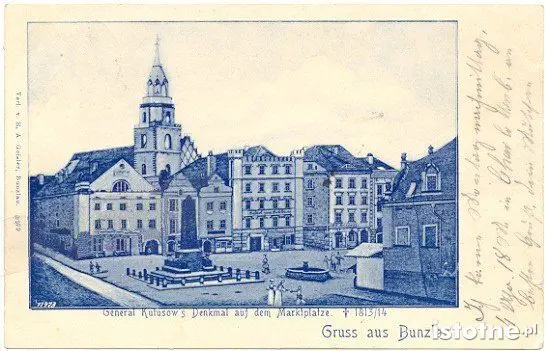
Initially, the monument was located in the Market Square, beside the town hall. In 1893, it was moved to the promenade on B. Kubika Street. There, in its new arrangement among trees and shrubs, it presented an impressive appearance. The immediate reason for the relocation was the renovation of the town hall and traffic problems resulting from the difficulties it caused for the construction work. One indirect reason for the change of location may be found in the shift in alliances on the European political scene after Bismarck’s death and the redirection of Russian policy toward France, with the alliance with Germany becoming marginal.
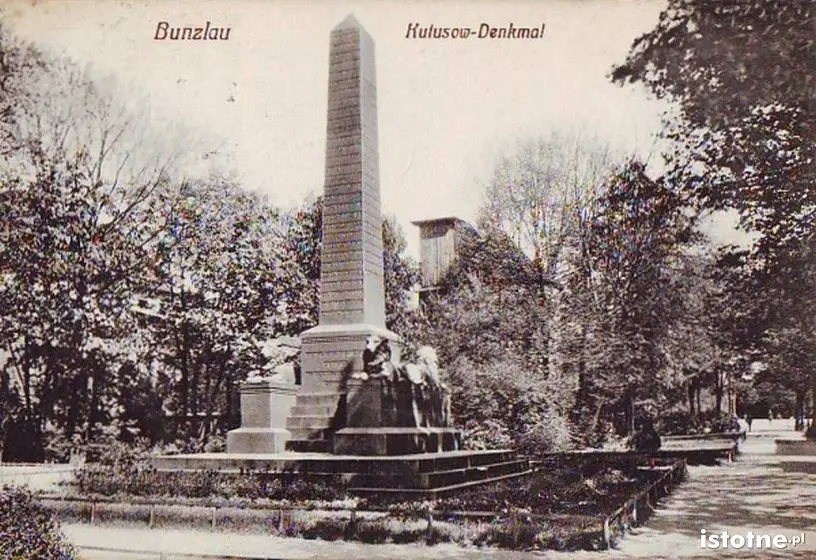
The monument was designed by Karl Schinkel and created at the Royal Iron Foundry in Berlin from material prepared at the royal steelworks in Gliwice, while the likenesses of the lions were made by Johann Schadow. The monument is approximately 12 meters and 50 centimeters high. It takes the form of a tall obelisk referring to the culture of the ancient Egyptians. The lions at the foot of the obelisk were intended to symbolize valor, courage, strength, and victory, while the monument itself was meant to express the ideas of permanence, endurance, and remembrance of the general.
Today, the monument is one of the city’s symbols and, as before World War II, is often featured on postcards. In a sense, it connects the history of German Bunzlau and Polish Bolesławiec, but it should be remembered that Kutuzov was an opponent of Napoleon, while Poles in the French army fought to regain their state.



Sebastian Zielonka – historian and graduate of the University of Wrocław. Specializes in archival studies and conservation documentation. He is interested in the history of the region and the social life of Europeans in the 20th century. In his free time, he travels.
Sources: A. Kozioł, Promenada w Bolesławcu, Bolesławiec 2010; M. Olczak, J. Moniatowicz, Bolesławiec. Przewodnik historyczny; Wratislaviae Amici.