
The first references to Jewish settlement in Bolesławiec date back to the 14th century. Surviving materials tell us that around 360 people of the Mosaic faith lived here in 1370. They were mainly engaged in trade and services. In 1454, they were expelled from the city amid rising antisemitic sentiment, and it was not until the beginning of the 19th century that they began rebuilding their religious community from scratch. By comparison: in 1822, 22 Jews were living in the city, while by the end of the century Bolesławiec was already home to 194 people of the Mosaic faith.
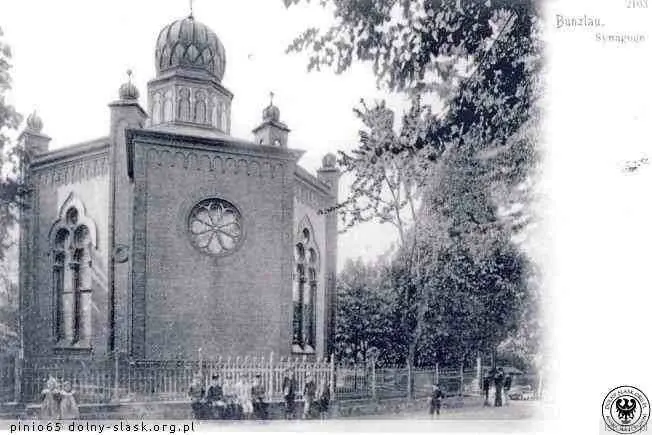
As a religious community observing its worship practices, the Jews sought to establish a building in the city where religious rituals could be conducted. The first prayer room was established in 1823 in the home of the widow Böhm. In 1876, after considerable efforts, construction began on the Bolesławiec synagogue on what is now Kubika Street. It was located in an exclusive part of Bolesławiec: by the promenade and not far from the “Odeon” concert and ballroom.
The site for the building was carefully selected—next to the former Jewish district. The construction was initiated by the merchant Israel Hülse, while the investment was funded by the banker Sachs. The project cost approximately 50,000 marks.
Unfortunately, during Kristallnacht (9 November 1938), the synagogue was set on fire, while the fire brigade ensured that the flames did not spread to the neighboring buildings. The building was never rebuilt, and today a small square occupies the site of the former synagogue. Today, the history of Bolesławiec’s Jews can be admired in surviving postcards.




Sebastian Zielonka – historian and graduate of the University of Wrocław. His specializations are archival science and conservation documentation. He is interested in the history of the region and the social life of Europeans in the 20th century. In his free time, he travels.
(information: Sebastian Zielonka)